
Play Sizzling Hot Now!
Home → Strategy
Sizzling Hot Strategy
Approaching Sizzling Hot sensibly
Sizzling Hot, developed by Novomatic in 2003, operates with a theoretical return of 95.66% across its standard configuration. This percentage indicates that the house retains an edge of 4.34% over extremely long play sessions, meaning players should expect gradual capital erosion rather than immediate profit. Consequently, treating this title as entertainment rather than income generation is the only logical approach to maintaining financial stability during gameplay.
The game features medium volatility alongside a maximum win cap of 5000x, which balances frequent small payouts against rare large strikes. This specific risk profile ensures that bankroll depletion occurs slowly enough to allow for extended playing time compared to high-variance alternatives. Players utilizing flat betting strategies can better withstand the natural variance inherent in this five-line slot structure without risking rapid ruin.
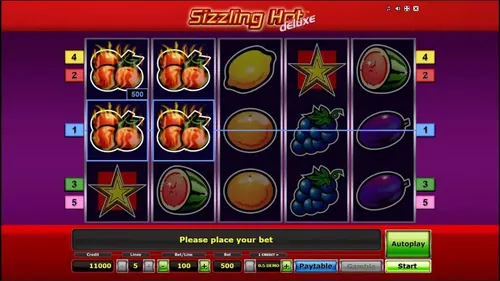
In contrast, Sizzling Hot Deluxe shares the identical 95.66% RTP and 5000x max win parameters but offers a slightly different visual interface. While the core mathematical model remains unchanged between these two Novomatic releases, the classic fruit symbols on the original version provide a simpler payout landscape. Understanding this consistency helps players manage expectations regarding potential returns when switching between the standard and deluxe iterations of the same engine.
Bankroll rules that hold up
A dedicated bankroll must be strictly separated from personal finances to ensure that losses on Sizzling Hot do not impact daily living expenses. Novomatic’s 95.66% RTP implies a 4.34% house edge, requiring players to budget for inevitable downswings over thousands of spins on the 5x3 grid. Setting a fixed loss limit before starting protects the player from chasing deficits in a game designed for long-term mathematical retention.
The welcome bonus offering 300% up to €2,000 plus 100 free spins provides additional funds to extend playtime on this Novomatic title. However, wagering requirements associated with such promotions often restrict withdrawal eligibility until specific turnover targets are met within defined timeframes. Players must calculate the total turnover needed relative to their deposit to determine if the extra credit justifies the restrictive conditions imposed by the operator.
Progressive staking systems that raise bets after losses fail to alter the built-in 4.34% edge present in every spin of Sizzling Hot. Increasing stakes merely accelerates the rate of bankroll depletion without improving the probability of hitting the 5000x maximum win or triggering any special features. Maintaining a consistent stake size preserves the bankroll longer, allowing the statistical average to potentially stabilize over a larger sample size of rounds.
Bet sizing against volatility
Sizzling Hot utilizes a 5x3 reel layout with exactly five paylines, creating a medium volatility environment that dictates optimal bet sizing strategies. Medium volatility suggests that wins occur with moderate frequency, allowing players to sustain their session length by avoiding excessive single-round stakes relative to their total balance. Allocating no more than one percent of the total bankroll per spin minimizes the risk of rapid exhaustion during unfavorable streaks.
The absence of wild symbols and free spins in the base game means that winning combinations rely solely on matching classic fruit symbols or red Sevens. Without these common modern features to boost hit frequency, players must adjust their bet sizes to account for potentially longer dry spells between payouts. A conservative approach ensures that the bankroll survives the variance inherent in a five-line slot lacking complex bonus mechanics or scatter-triggered rounds.
Comparing this to Sizzling Hot Deluxe, which maintains the same 95.66% RTP and 5000x max win potential, reveals similar betting constraints despite visual upgrades. Both titles require careful management of the stake-to-balance ratio due to their shared medium volatility classification and lack of progressive jackpot accumulation. Players should recognize that neither version offers guaranteed short-term returns, necessitating disciplined bet sizing to navigate the mathematical reality of the house edge.
Session limits worth setting
Setting a strict time limit for playing Sizzling Hot prevents fatigue-induced errors and helps maintain rational decision-making throughout the session. Novomatic’s design with a 95.66% RTP encourages prolonged engagement, making it easy to lose track of time while waiting for the 5000x maximum win. Establishing a predefined end point ensures that players stop while they are still ahead or have lost only within their predetermined acceptable boundaries.
A loss limit equal to twenty-five percent of the initial bankroll serves as a hard stop for any Sizzling Hot playing session. Since the game carries a 4.34% house edge, extended play inevitably leads to negative variance, and capping losses prevents catastrophic financial damage. Reaching this threshold triggers an automatic exit, protecting the remaining funds from being wiped out by the mathematical certainty of long-term erosion.
The Gamble feature allows players to double winnings after certain wins, but using it excessively can quickly deplete a session’s profits. Engaging in repeated gambles introduces binary risk that contradicts the medium volatility profile intended for steady, smaller gains from the fruit symbols. Limiting the use of this optional mechanic to a few instances per session preserves the bankroll integrity established by the initial deposit and flat betting strategy.
Why chasing losses fails
Chasing losses on Sizzling Hot ignores the immutable 4.34% house edge embedded in every spin of the Novomatic-developed game. Increasing bets to recover previous deficits does not change the underlying probability of landing five cherries or red Sevens on the active paylines. This behavior typically accelerates bankroll depletion because the mathematical expectation remains negative regardless of the stake size applied to the five-line grid.
The maximum win of 5000x represents a rare statistical outlier rather than a reliable target for recovery strategies in Sizzling Hot. Attempting to force this outcome by escalating wagers after losses exposes the player to extreme variance that usually results in total bankroll exhaustion. The game’s medium volatility ensures that such aggressive tactics will likely lead to ruin before the rare large win can materialize to offset earlier deficits.
Unlike games with skill-based elements, Sizzling Hot relies entirely on random number generation, making past outcomes irrelevant to future spin results. The presence of a Star Scatter symbol does not influence the probability of subsequent wins, rendering any pattern-based chasing strategy mathematically futile. Accepting losses as part of the cost of entertainment associated with the 95.66% RTP is the only sustainable approach to managing funds in this slot.
Sizzling Hot: key facts
| Parameter | Value |
|---|---|
| Game | Sizzling Hot |
| Studio | Novomatic |
| Released | 2003 |
| RTP | 95.66% |
| House edge | 4.34% |
| Volatility | medium |
| Max win | 5000x |
| Reels | 5x3 |
| Paylines / ways | 5 lines |
Common systems and their limits
Sizzling Hot is a 5x3 slot from Novomatic with a theoretical RTP of 95.66%, establishing a fixed house edge of 4.34% that applies to all bets regardless of the strategy employed by the player during the session.
The maximum win cap sits at 5000x, which restricts potential payouts even when utilizing progressive staking methods that raise stakes after losses, as this approach does not alter the built-in mathematical edge over time.
In contrast, Indian Spirit offers a slightly different RTP of 95.34% with medium volatility, showing how alternative operator builds can vary returns while maintaining similar reel structures and feature sets across the Novomatic portfolio.
Flat betting explained
Flat betting requires placing the same stake every round on Sizzling Hot, ensuring that the bankroll depletes at a predictable rate determined solely by the 95.66% RTP and the number of spins executed per hour.
This method avoids the risks associated with raising stakes after losses, as flat betting preserves capital longer than progressive systems by keeping exposure constant and preventing rapid depletion of the total funds set aside for play.
The game features five paylines and classic fruit symbols without wild cards, meaning consistent small bets allow players to experience the medium volatility profile without the severe drawdowns caused by aggressive betting adjustments.
Progressive staking risks
Raising stakes after losses in Sizzling Hot accelerates the time to ruin because the 4.34% house edge remains unchanged, making it impossible to recover deficits through bet size manipulation alone over the long run.
The Gamble feature offers an additional risk layer where players can wager winnings on red or black, but this mechanic does not improve the overall return and often leads to faster exhaustion of the bankroll compared to standard play.
Unlike Indian Spirit which maintains a steady 95.34% return, attempting to beat the system on Sizzling Hot using progressive methods ignores the fact that each spin is independent and the maximum win cap of 5000x remains the hard limit.
What the maths actually allows
The 95.66% RTP means that for every 100 units wagered on Sizzling Hot, the theoretical return is 95.66 units, creating a guaranteed loss of 4.34 units per hundred over hundreds of thousands of spins.
Alternative operator builds may offer lower RTPs of 92.28% or 90.02%, which significantly increase the house edge and reduce the expected value for players who choose these specific versions of the Novomatic title instead of the standard release.
With a medium volatility rating, players can expect frequent small wins interspersed with larger payouts, but the Star Scatter and Red Sevens do not change the fundamental mathematics governing the long-term performance of the game.
Reading variance honestly
Medium volatility in Sizzling Hot balances the frequency of hits with the size of payouts, allowing players to endure dry spells without exhausting their bankroll too quickly while still chasing the maximum win of 5000x.
The absence of free spins and wild symbols means that variance relies entirely on the base game combinations, requiring patience to trigger the Star Scatter or land multiple Red Sevens on the five active paylines.
Comparing this to Indian Spirit, which also has medium volatility but a 95.34% RTP, highlights how slight differences in mathematical design affect the duration of play and the likelihood of hitting significant multipliers within a single session.
Learning the game in demo first
Novomatic released Sizzling Hot in 2003 as a five-reel, three-row fruit slot with exactly five paylines. The theoretical return is set at 95.66%, meaning the house retains 4.34% of all wagers over time. Players can test this math without risking capital by using the free play mode available on many sites.
The medium volatility indicates that wins occur with moderate frequency and size, avoiding extreme dry spells or massive jackpots. This balance suits readers who prefer steady engagement over high-risk gambles typical of other titles. Testing the demo reveals how the red Sevens and Star Scatter symbols trigger payouts on these specific lines.
Unlike Alles Spitze which offers high volatility and a smaller 500x max win, Sizzling Hot provides a 5000x maximum win potential. Understanding this difference helps players set realistic expectations for their bankroll longevity. Familiarity with the Gamble feature allows users to see if doubling winnings aligns with their risk tolerance before depositing real money.
Adjusting stakes to your budget
The bonus terms offer a 300% welcome bonus up to €2,000 plus 100 free spins, which significantly extends playing time. A flat betting strategy keeps the stake constant every round, preventing rapid depletion of the initial bankroll. This method ensures that the built-in 4.34% house edge remains the only variable affecting long-term results.
Progressive staking involves raising stakes after losses, a practice that accelerates the time to ruin without altering the mathematical edge. For example, increasing bets during a losing streak does not improve the odds of recovering funds on a 5-line slot. Maintaining a fixed bet size preserves the structural integrity of the session against variance.
Comparing this approach to Alles Spitze highlights why lower volatility games often suit conservative budgets better. While Alles Spitze has a 90.85% RTP and high volatility, Sizzling Hot's 95.66% RTP offers a slightly better theoretical return. Players should calculate their total turnover requirement against the bonus value to ensure they do not exceed their financial limits.
Recognising a bad session
A session becomes statistically unfavorable when the actual return deviates significantly from the 95.66% theoretical RTP over a short period. If a player experiences a prolonged series of non-winning spins, the medium volatility suggests this is within normal distribution parameters. However, persistent losses may indicate that the current stake level exceeds the sustainable portion of the bankroll.
The presence of alternative RTP configurations, such as 92.28% or 90.02%, means some operator builds have a higher house edge than the standard 4.34%. Playing on a version with 92.28% RTP increases the cost per spin compared to the optimal configuration. Recognizing this variation prevents confusion when results do not match expected theoretical returns.
Tracking the number of spins versus the remaining balance provides a clear metric for session health. If the bankroll depletes faster than the rate predicted by the 4.34% house edge, the player may be engaging in risky behavior like chasing losses. Stopping immediately upon reaching a predetermined loss limit protects the remainder of the funds from further erosion.
Stopping while ahead
The maximum win cap of 5000x represents the highest possible payout from a single bet combination in Sizzling Hot. Securing this amount or any significant profit early in the session locks in gains against the inevitable regression to the mean. Since the game lacks wild symbols and free spins, big wins rely on hitting specific combinations of red Sevens or Scatters.
With an RTP of 95.66%, the long-term expectation is always negative, making withdrawal strategies essential for preserving short-term profits. Setting a target profit margin, such as 50% of the initial deposit, provides a clear exit point before variance erodes the advantage. This discipline contrasts with players who reinvest winnings into progressive staking systems that increase exposure to the house edge.
Comparing the 5000x max win to Alles Spitze's 500x shows that Sizzling Hot offers greater upside potential for disciplined players. Achieving this multiplier requires patience and adherence to the five payline structure without deviating into higher-risk behaviors. Cashing out after hitting a substantial fraction of this cap ensures that the session ends on a positive financial note rather than a speculative gamble.
Responsible play in practice
Defining bankroll as the specific sum of money allocated solely for entertainment purposes prevents interference with essential living expenses. Using this defined amount ensures that losses remain contained within acceptable boundaries regardless of the outcome. This separation is critical because the 4.34% house edge guarantees that all players lose money over extended periods.
The absence of a cash-out button in this slot type reinforces the need for external self-control mechanisms rather than relying on game features. Players must manually stop playing once their pre-set time or loss limits are reached, as the interface does not enforce these boundaries. This manual intervention is necessary because the medium volatility can create illusions of control during winning streaks.
Verifying the licensing status of the operator ensures that the stated 95.66% RTP is accurate and not manipulated. Reputable regulators audit these figures to confirm that the game behaves according to its published mathematics. Without this verification, players risk encountering unlicensed platforms where the actual return could be lower than the advertised theoretical percentage.
DemoRTP & VolatilitySymbols & PayoutsBonus FeaturesStrategyBonusesMobileDownload & AppMax WinSimilar GamesReviewFAQSitemap
Sizzling Hot 2026